

Video of the Letter Alif:
This short video presents the Makhraj and characteristics of the letter Alif , demonstrating its correct pronunciation with Qur’anic examples, and highlighting common pronunciation errors madeby readers.
To enable the translation option, please click on 
First: The Articulation Point (Makhraj) of the Letter Alif:
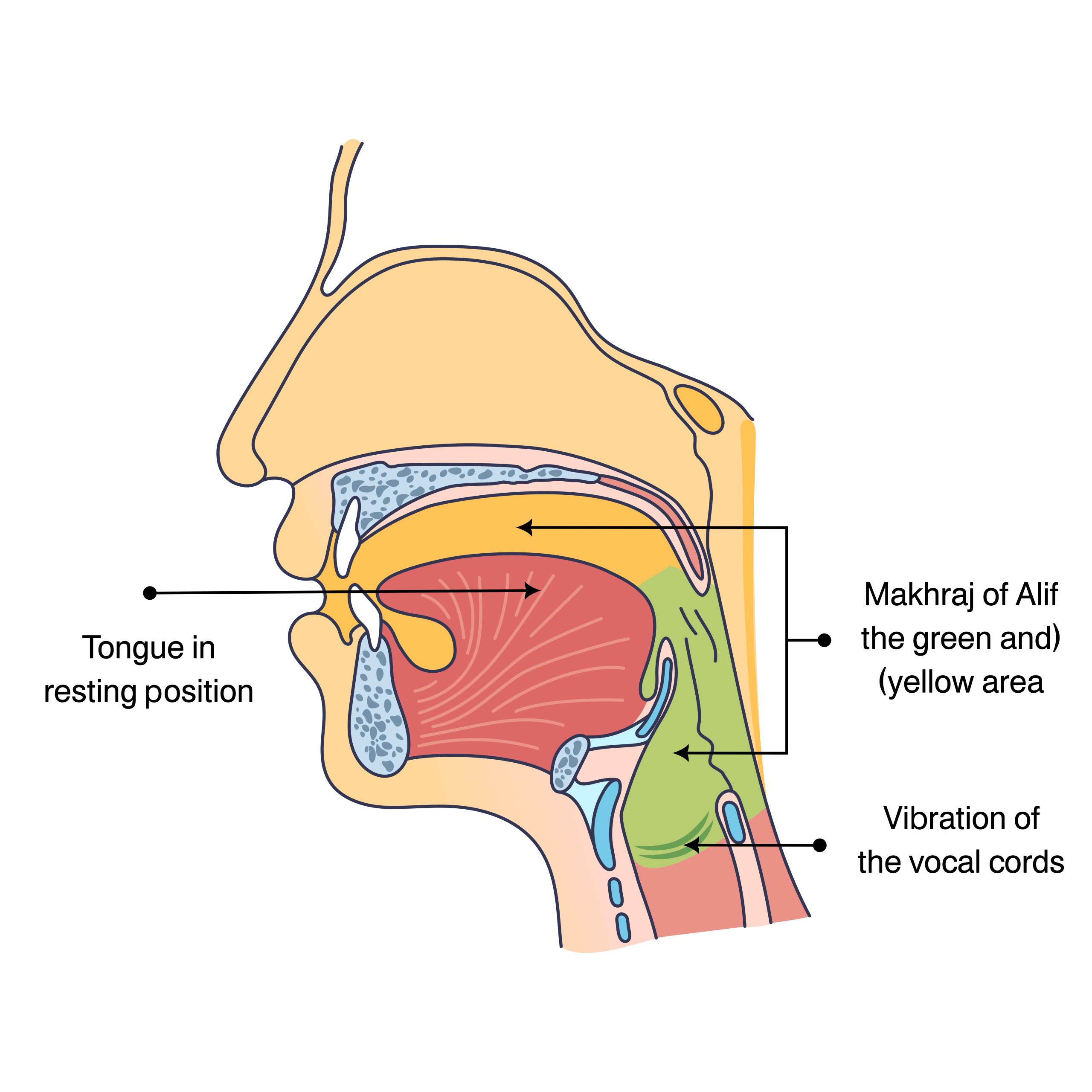
Alif is pronounced from the empty space in the mouth and throat (al-jawf), accompanied by vibration of the vocal cords in the larynx (al-ḥanjara), and an opening of the mouth. The tongue remains in a resting position, as shown in the first image.
Second: The Most Important Characteristics of the Letter Alif:
Its primary feature is istifāl (non-elevation of the back of the tongue).
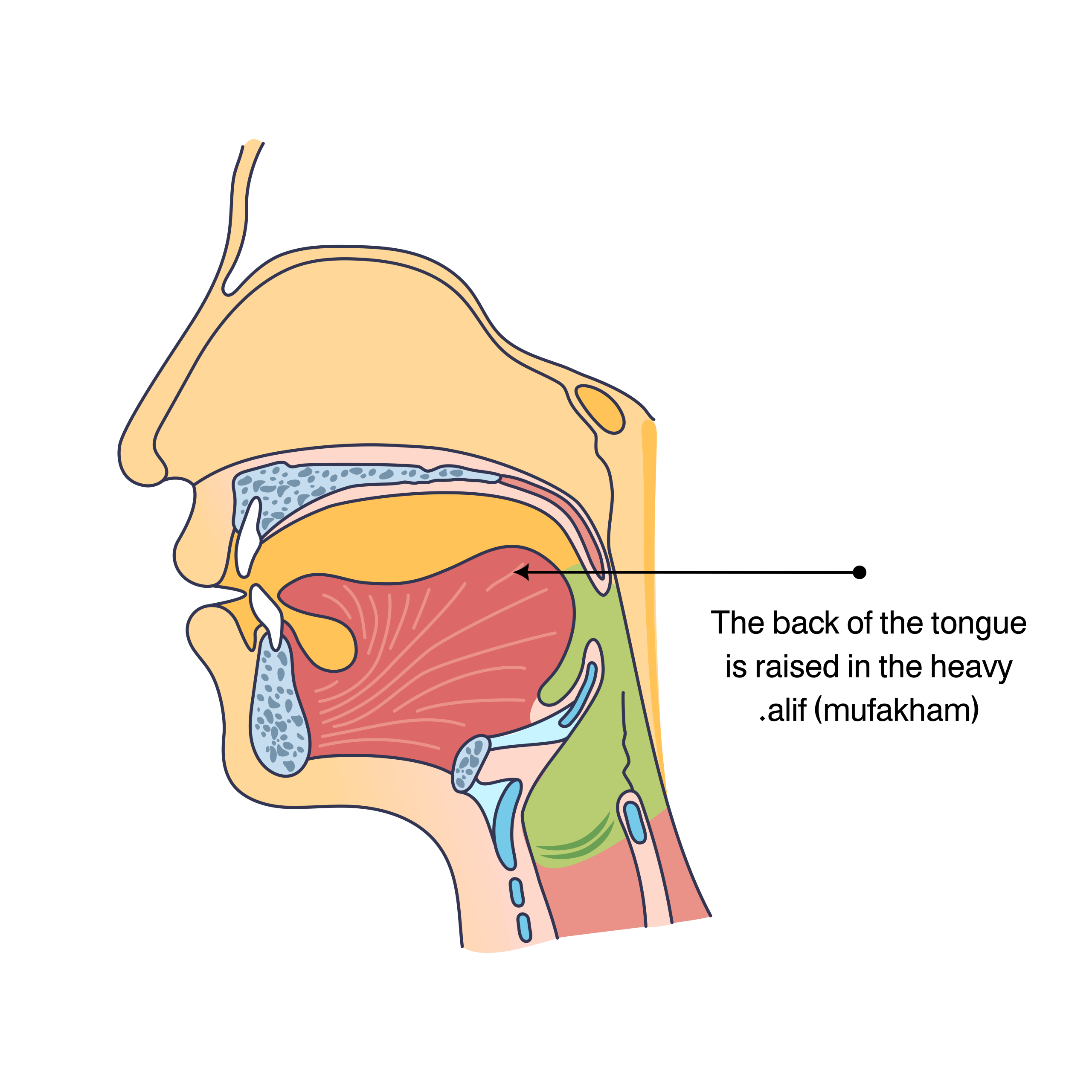
The explanatory image shows the lowering of the distant part of the tongue (its end toward the throat) and the opening of the throat. This renders the sound of Alif light (muraqqaq). However, Alif may be heavy (mufakham) if preceded by a heavy letter, the back of the tongue will be raised, as shown in the second picture.
These heavy letters are:(خ، ص، ض، غ، ط، ق، ظ). Further elaboration on the rules of Alif will follow, in shā’ Allāh.
Additionally, the letter Alif is always non-voweled (sukūn) preceded by a fatha. Therefore, it is never doubled (shaddah), nor does it occur at the beginning of a word—because in Arabic, words do not begin with a non-vowelled letter.
Third: Pronouncing Alif through Qur’anic Examples:
You can click on the word to hear the correct pronunciation.
| بَا | تَا | حَا | صَا | ظَا | قَا |
|---|---|---|---|---|---|
| ﴿بَايَعۡتُم﴾ | ﴿تَابُواْ﴾ | ﴿حَاجَةٗ﴾ | ﴿صَٰعِقَةٗ﴾ | ﴿ظَٰلِمِينَ﴾ | ﴿قَارِعَةٌ﴾ |
Fourth: Common Mistakes in Pronouncing Alif:
- • Pronouncing it heavily (tafkhīm) where it should be light, especially when followed by a heavy letter, such as: ﴿ٱلنَّهَارِ﴾ . The correct pronunciation is to pronounce it lightly (Muraqqaq) because it was preceded by a light letter: ﴿ٱلنَّهَارِ﴾ . Allah says: ﴿يُولِجُ ٱلَّيۡلَ فِي ٱلنَّهَارِ﴾ .
• Pronouncing it lightly where it should be heavy, as in: ﴿خَٰلِدِينَ﴾ . The correct way is to pronounce it heavily because it was preceded by a heavy letter: ﴿خَٰلِدِينَ﴾ . Allah says: ﴿خَٰلِدِينَ فِيهَآ أَبَدٗا﴾ .
• Blending its sound with Ghunnah (nasal sound), which is called nasalization, especially near Nūn or Mīm, by allowing part of the sound to pass through the nose, like: ﴿ٱلرَّحۡمَٰنُ﴾ . The correct pronunciation is to avoid nasalization: ﴿ٱلرَّحۡمَٰنُ﴾ . Allah says: ﴿ٱلرَّحۡمَٰنُ فَسَۡٔلۡ بِهِۦ خَبِيرٗا﴾ .
• Blending it with the sound of Wāw by rounding the lips when it is next to heavy letters, like: ﴿صَٰدِقِينَ﴾ . Correct pronunciation is pronouncing it without rounding lips: ﴿صَٰدِقِينَ﴾ . Allah says: ﴿إِن كُنتُمۡ صَٰدِقِينَ﴾ .
• Blending it with the sound of Yā’, turning it into an *Alif Momalah*, as in: ﴿ٱلۡكَٰفِرِينَ﴾ . The correct way is: ﴿ٱلۡكَٰفِرِينَ﴾ . Allah says: ﴿وَٱللَّهُ لَا يَهۡدِي ٱلۡقَوۡمَ ٱلۡكَٰفِرِينَ﴾ .
• Exaggerating the waviness of its sound, especially when it is elongated, such as: ﴿ٱلضَّآلِّينَ﴾ . The correct form is: ﴿ٱلضَّآلِّينَ﴾ . Allah says: ﴿غَيۡرِ ٱلۡمَغۡضُوبِ عَلَيۡهِمۡ وَلَا ٱلضَّآلِّينَ﴾ .
نهاية القول المفيد (49)، هداية القاري (1/65)، التجويد المصور (43).
الرعاية (161)، هداية القاري (1/95)، نهاية القول المفيد (87)، التجويد المصور (30، 98)، المنير (95).
هداية القاري (1/95)، التجويد المصور (30).