

1. الحروف العربية
-
Introductions
Introduction to the Science of Tajwīd1 اختبار -
The Ruling on Learning Tajwīd1 اختبار
-
Etiquettes Related to the Qur’an and Its Recitation1 اختبار
-
Levels of Recitation1 اختبار
-
Seeking Refuge (Istiʿādhah) and the Basmalah1 اختبار
-
Arabic Letters – Articulation and CharacteristicsArticulation Points of Arabic Letters1 اختبار
-
The Jawf (oral and throat cavity):1 اختبار
-
Alif Maddiyyah1 اختبار
-
Wāw Maddiyyah1 اختبار
-
Yāʾ Maddiyyah1 اختبار
-
The Throat (Ḥalq)1 اختبار
-
Hamzah1 اختبار
-
Hāʾ1 اختبار
-
ʿAyn1 اختبار
-
Ḥāʾ1 اختبار
-
Ghayn1 اختبار
-
Khāʾ1 اختبار
-
The Tongue (Lisān)1 اختبار
-
Qāf1 اختبار
-
Kāf1 اختبار
-
Jīm1 اختبار
-
Shīn1 اختبار
-
Yāʾ (non-maddiyyah)1 اختبار
-
Ḍād1 اختبار
-
Lām1 اختبار
-
Nūn1 اختبار
-
Rāʾ1 اختبار
-
Ṭāʾ1 اختبار
-
Dāl1 اختبار
-
Tāʾ1 اختبار
-
Ṣād1 اختبار
-
Sīn1 اختبار
-
Zāy1 اختبار
-
Ẓāʾ1 اختبار
-
Dhāl1 اختبار
-
Thāʾ1 اختبار
-
The Lips and Nasal Cavity1 اختبار
-
Fāʾ1 اختبار
-
Wāw (non-maddiyyah)1 اختبار
-
Bāʾ1 اختبار
-
Mīm1 اختبار
Video of the Letter Rā’:
This short video presents the articulation and characteristics of the letter Rā’, demonstrating its correct pronunciation with Qur’anic examples, and highlighting common pronunciation errors made by readers.
First: The Articulation Point (Makhrāj) of Rā’:
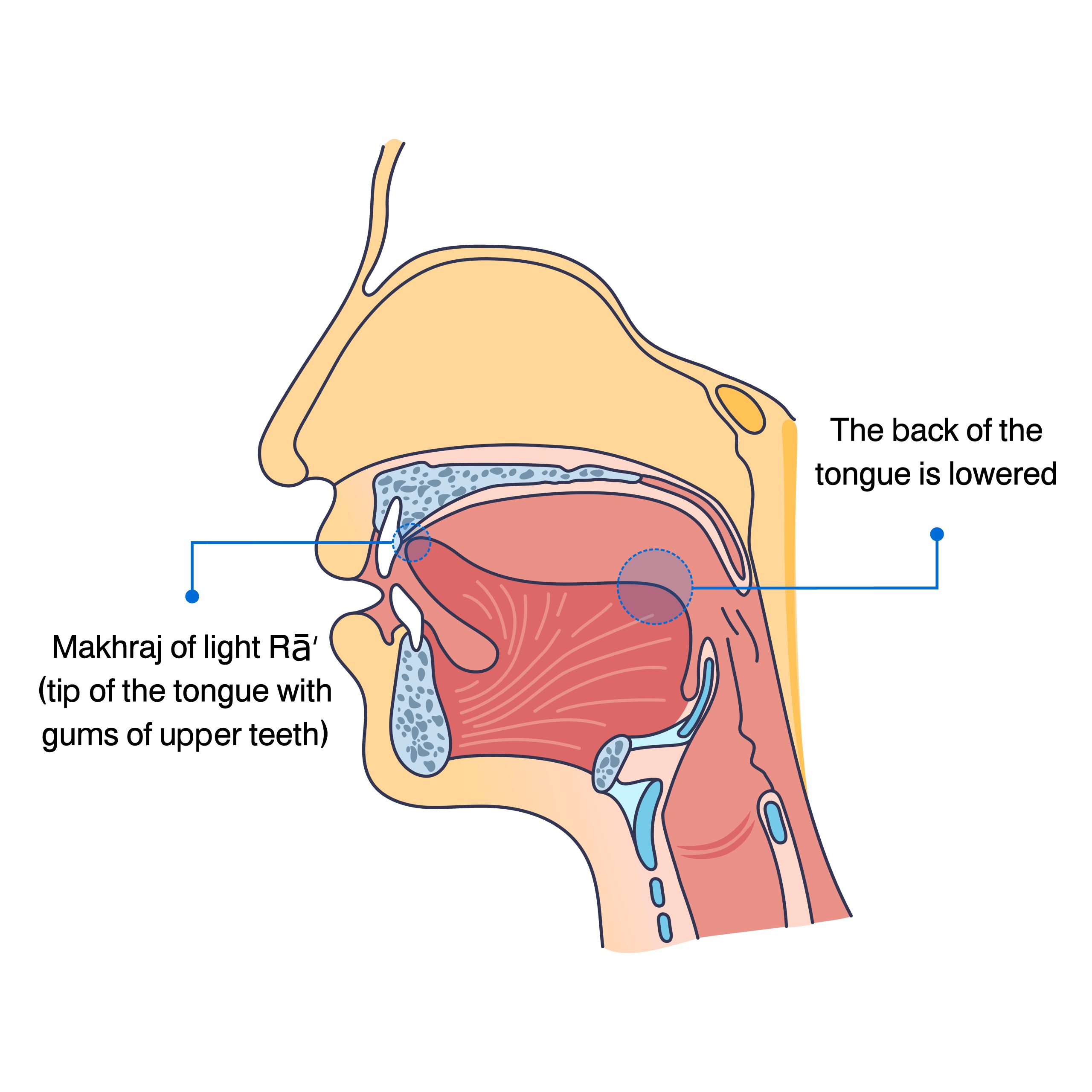
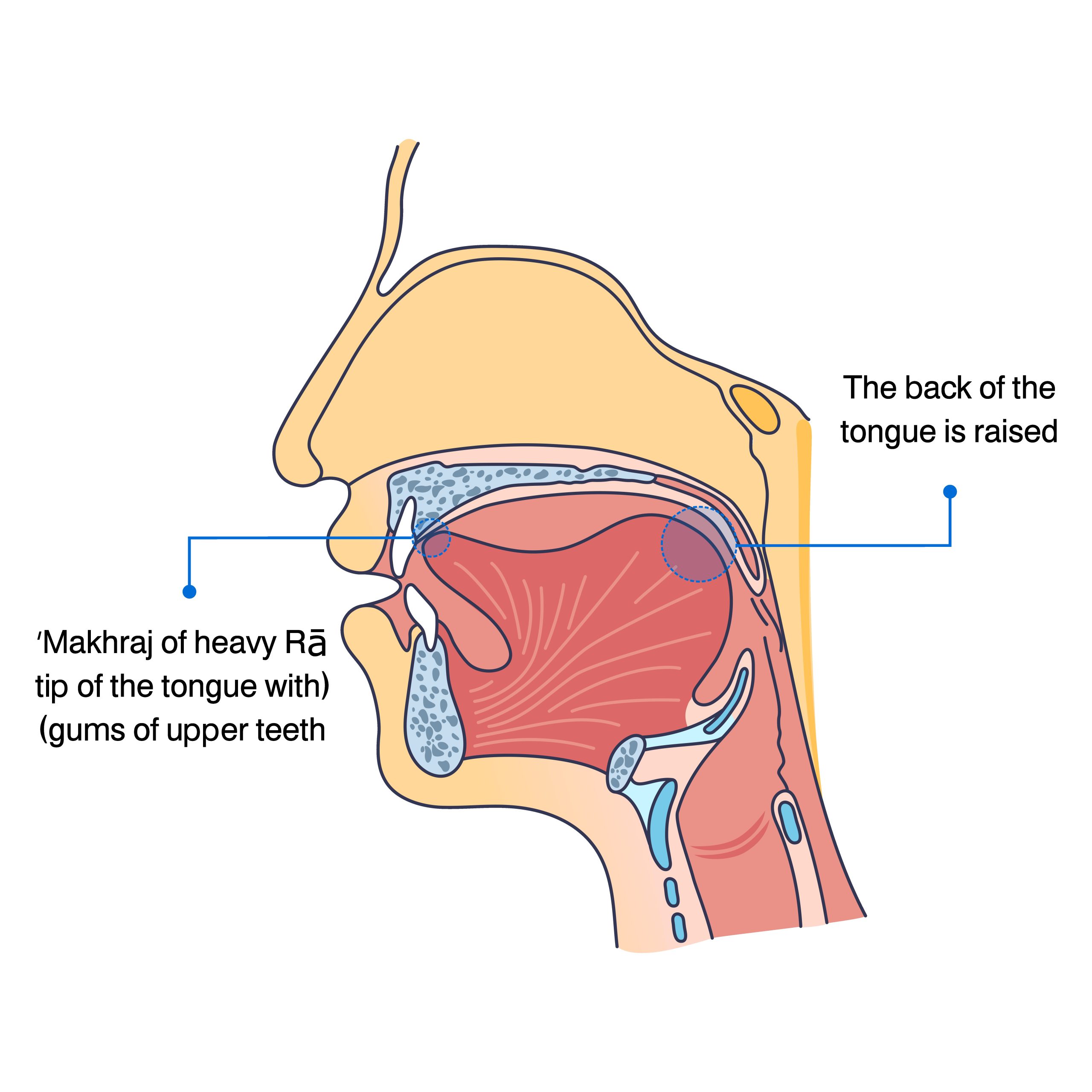
Rā’ is pronounced from the tip of the tongue with corresponding gums of upper teeth, close to the articulation point of the letter Nūn, as shown in the image.
Second: The Most Important Characteristics of Rā’:
Takrīr (repetition), Bayniyyah (partial flow), and Istifāl (lowering).
The image shows the tongue tip pressing against the gums of upper teeth. A small gap must be left to allow the sound to pass (without this gap sound cannot be heard)—Passing of sound through this gap causes a slight(hidden) shuddering in the tip of the tongue due to the sound passage through a tight space, this shuddering is known as takrīr (Repetition). The sound of Rā’ thus flows partially, which is the characteristic of Bayniyyah.
Care must be taken not to exaggerate the Takrīr, which would produce more than one Rā’ sound.
Rā’ is generally a lowering (Istifāl) letter, but it can be either light (Muraqqaq) or heavy (Mufakham) depending on the situation. In a light (Muraqqaq) state, the back of the tongue remains low when pronouncing it. In a heavy state (Mufakham), the back of the tongue is raised when pronouncing it. These conditions will be detailed later, in shā’ Allāh.
Third: Pronouncing Rā’ through Qur’anic Examples:
You can click on the word to hear the correct pronunciation.
| أولاً: الراء في حال السكون | ||
|---|---|---|
| أَرْ | أُرْ | إِرْ |
| ﴿أَرۡبَعِينَ﴾ | ﴿تُرۡجَعُونَ﴾ | ﴿مِرۡيَةٖ﴾ |
| ثانيًا: الراء مع الحركات | ||
|---|---|---|
| رَ | رُ | رِ |
| ﴿رَيۡبٖ﴾ | ﴿رُّبَمَا﴾ | ﴿رِزۡقٗا﴾ |
| ثالثًا: الراء مع حروف المد | ||
|---|---|---|
| را | رو | ري |
| ﴿رَانَ﴾ | ﴿رُّوحِنَا﴾ | ﴿رِيبَةٗ﴾ |
| رابعًا: الراء في حال التشديد | ||
|---|---|---|
| أَرَّ | أَرُّ | أَرِّ |
| ﴿ٱلرَّحۡمَٰنِ﴾ | ﴿ٱلرُّسُلُ﴾ | ﴿ٱلرِّيَٰحِ﴾ |
Fourth: Common Mistakes in Pronouncing Rā’:
- أولاً: المبالغة في تكرير الراء، إذا كانت مشددة أو ساكنة، نحو: ﴿ٱلرَّزَّاقُ﴾، والصواب: ﴿ٱلرَّزَّاقُ﴾، قال الله تعالى: ﴿إِنَّ ٱللَّهَ هُوَ ٱلرَّزَّاقُ ذُو ٱلۡقُوَّةِ ٱلۡمَتِينُ﴾. وكما في كلمة: ﴿أَرۡسَلۡنَا﴾، والصواب: ﴿أَرۡسَلۡنَا﴾، قال الله تعالى: ﴿كَمَآ أَرۡسَلۡنَا فِيكُمۡ رَسُولٗا مِّنكُمۡ﴾.
- • Pronouncing it like an intense letter (Shadid) without bayniyyah: ❌ ﴿ٱلرَّحۡمَٰنِ﴾ → ✅ ﴿ٱلرَّحۡمَٰنِ﴾(Correct way is to allow partial flow of sound) ▶ Allah says: ﴿ٱلرَّحۡمَٰنِ ٱلرَّحِيمِ﴾
- • Pronouncing it like Wāw with afloating sound: ❌ ﴿ٱلرُّسُلُ﴾ → ✅ ﴿ٱلرُّسُلُ﴾ ▶ Allah says: ﴿مِن قَبۡلِهِ ٱلرُّسُلُ﴾
- • Substituting it with Ghayn: ❌ ﴿رَبَّنَا﴾ → ✅ ﴿رَبَّنَا﴾ ▶ Allah says: ﴿رَبَّنَا تَقَبَّلۡ مِنَّا﴾
- • Rounding the lips while pronouncing it when it is heavy(Mufakham): ❌ ﴿أَرۡجِهۡ﴾ → ✅ ﴿أَرۡجِهۡ﴾(Correct way : don’t rounds lips forwardwhen pronouncing it) ▶ Allah says: ﴿أَرۡجِهۡ وَأَخَاهُ﴾
- • Making it silent(not pronouncing it clearly) when stopping on it: ❌ ﴿وَٱلۡعَصۡرِ﴾ → ✅ ﴿وَٱلۡعَصۡرِ﴾(Correct way is to properly articulate it and make its sound apparent) ▶ Allah says: ﴿وَٱلۡعَصۡرِ * إِنَّ ٱلۡإِنسَٰنَ لَفِي خُسۡرٍ﴾
الرعاية (195)، التحديد (105)، نهاية القول المفيد (53)، هداية القاري (1/68)، التجويد المصور (55)، المنير (62).
الرعاية (193)، نهاية القول المفيد (108)، هداية القاري (1/96)، التجويد المصور (97)، المنير (95).