

1. الحروف العربية
-
Introductions
Introduction to the Science of Tajwīd1 اختبار -
The Ruling on Learning Tajwīd1 اختبار
-
Etiquettes Related to the Qur’an and Its Recitation1 اختبار
-
Levels of Recitation1 اختبار
-
Seeking Refuge (Istiʿādhah) and the Basmalah1 اختبار
-
Arabic Letters – Articulation and CharacteristicsArticulation Points of Arabic Letters1 اختبار
-
The Jawf (oral and throat cavity):1 اختبار
-
Alif Maddiyyah1 اختبار
-
Wāw Maddiyyah1 اختبار
-
Yāʾ Maddiyyah1 اختبار
-
The Throat (Ḥalq)1 اختبار
-
Hamzah1 اختبار
-
Hāʾ1 اختبار
-
ʿAyn1 اختبار
-
Ḥāʾ1 اختبار
-
Ghayn1 اختبار
-
Khāʾ1 اختبار
-
The Tongue (Lisān)1 اختبار
-
Qāf1 اختبار
-
Kāf1 اختبار
-
Jīm1 اختبار
-
Shīn1 اختبار
-
Yāʾ (non-maddiyyah)1 اختبار
-
Ḍād1 اختبار
-
Lām1 اختبار
-
Nūn1 اختبار
-
Rāʾ1 اختبار
-
Ṭāʾ1 اختبار
-
Dāl1 اختبار
-
Tāʾ1 اختبار
-
Ṣād1 اختبار
-
Sīn1 اختبار
-
Zāy1 اختبار
-
Ẓāʾ1 اختبار
-
Dhāl1 اختبار
-
Thāʾ1 اختبار
-
The Lips and Nasal Cavity1 اختبار
-
Fāʾ1 اختبار
-
Wāw (non-maddiyyah)1 اختبار
-
Bāʾ1 اختبار
-
Mīm1 اختبار
The Jawf (oral and throat cavity):
To enable the translation option, please click on 
Jawf: It is the empty space in the throat and mouth from the throat to the lips [1]. It is the first of the seventeen secondary (farʿiyyah) articulation points and is classified as an estimated Makhraj, meaning that the exact place of letter pronunciation is not determined, but estimated, and from it come out the three elongation (Madd) letters (alif, elongated waw , elongated ya’) [2]. The jawf Makhraj appears in this image in green and yellow colors, where green represents the throat cavity, and yellow represents the mouth cavity.
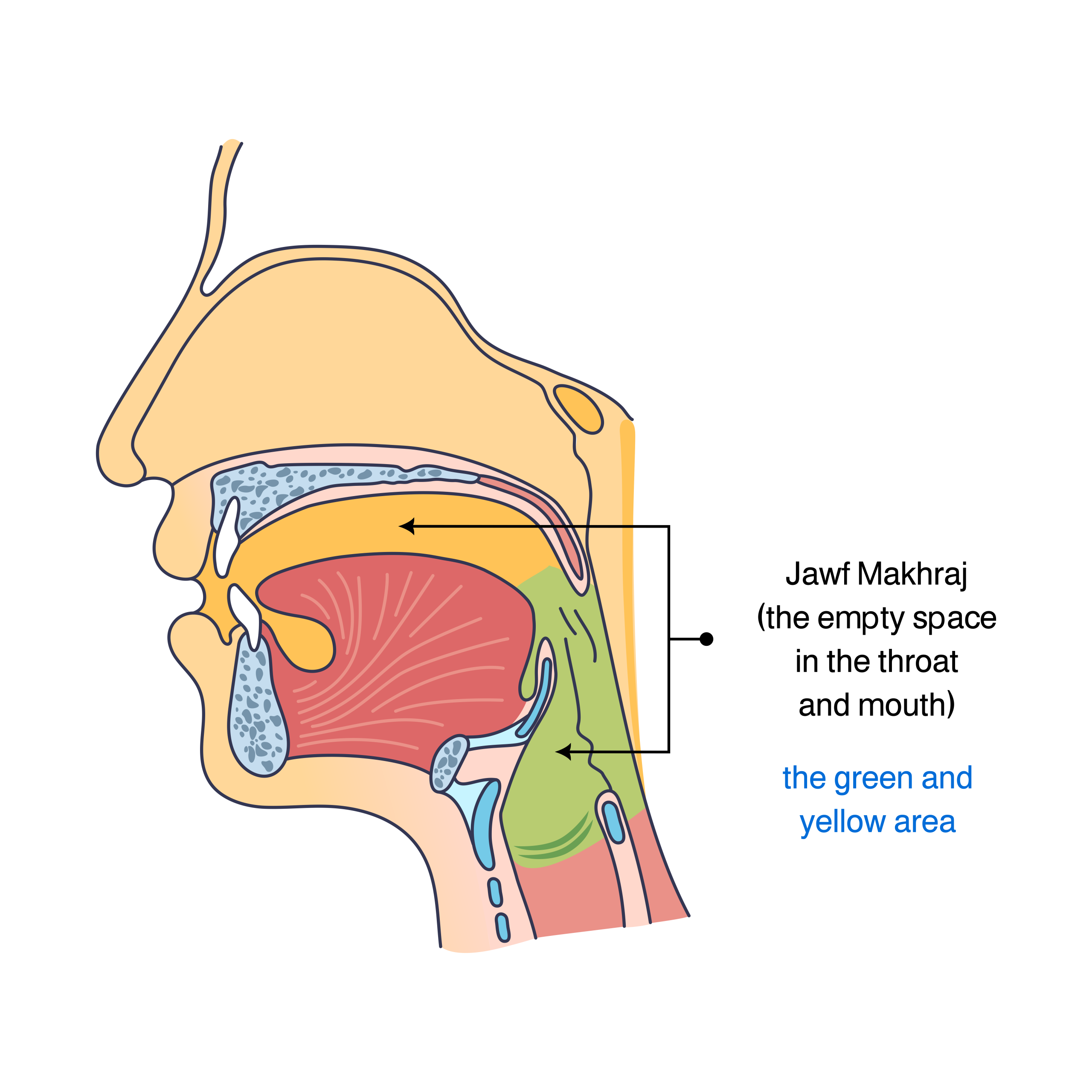
The three elongation letters were attributed to the jawf because they come out with the least compression of sound, so no specific place for their pronunciation is determined, but they end with the end of the sound; therefore they accepted the increase on natural elongation as will be explained in the chapter of elongations(Madd), inshAllah [3]. Unlike non-elongated waw and ya’ where sound compression is more, and their Makhrag are clearer [4]. As will be detailed later, InshAllah.
[1] Nihayat Al-Qawl Al-Mufid (49), Illustrated Tajweed (46), Al-Munir (50).
[2] Nihayat Al-Qawl Al-Mufid (49), Illustrated Tajweed (46), Al-Munir (50-51).
[3] Nihayat Al-Qawl Al-Mufid (49), Hidayat Al-Qari (1/65), Illustrated Tajweed (47).
[4] Nihayat Al-Qawl Al-Mufid (50), Illustrated Tajweed (47)